Automatic transfer switches
The box beside your meter decides how your house behaves when Duke, SECO, Clay or Ocala Electric goes dark. Here is how it works, which size fits, and what it costs.
Hurricane Milton, Oct 10, 2024
70,394Marion County electric customers out, 31.3% at the Florida PSC 9 AM report
Or call (352) 780-1430. A licensed installer who serves your area calls back, usually within one business day.
Watch the switch do its job
Press the button to cut the grid. The transfer switch disconnects your house from the utility line and connects it to the generator, then switches back when the grid returns.
Grid power on: the generator waits and runs a short self-test each week.
Four utilities, one box beside your meter
Free in-home estimate, written price, no obligation.
Get my estimateWho keeps your lights on depends on where you live. In Marion County, Ocala Electric Utility, the city's own utility, served about 56,000 customers in October 2024. Duke Energy Florida served about 78,907 Marion customers, SECO Energy about 72,900, and Clay Electric Cooperative about 16,605 (a 2022 count) across parts of north and northeast Marion. In Sumter, SECO served about 75,250 customers, with Withlacoochee River Electric covering a small share. Your electric bill tells you which one is yours.
They all fail the same way in a big storm. In Hurricane Irma, a county update counted 35,000 Ocala Electric Utility customers out and about 90% of Duke's Marion customers. In Milton, Florida PSC reports showed 21.3% of Ocala Electric customers out, about a quarter of Duke's, and up to 28.9% of SECO's Marion members.
The automatic transfer switch is the piece that makes all of that someone else's problem. It sits between the utility's lines and your panel, usually right beside the meter. It watches the incoming power around the clock, and when it fails, it starts the generator and moves your house over within seconds, whether you are home, asleep or a thousand miles away.
What happens in the first seconds of an outage
- It senses the outage. The switch monitors the utility lines continuously.
- It starts the generator. When utility voltage drops, it signals the generator to start.
- It transfers the load. Once the generator is up to speed, the switch disconnects your house from the utility and connects it to the generator, within seconds.
- It watches for the utility to return. When stable utility power is back, it moves the house back.
- It lets the generator cool down. The generator runs briefly without load, then shuts off and waits for the next outage or its weekly self-test.
Step 3 is also a safety feature. Disconnecting from the utility keeps generator power from flowing back onto the lines, where it could injure a lineworker who believes the wire is dead. After a hurricane, those crews are working your street. That is one reason the switch goes in under a permit, installed by a Florida licensed electrical contractor, and why a portable generator plugged into a dryer outlet is dangerous.
From inside the house, you notice a short blackout, then the lights come back. Clocks on appliances without battery backup may need resetting. Everything else just runs.
The short gap is by design. The switch waits for the generator to reach speed before it hands over the load, so motors and electronics get steady power rather than a stumbling start.
Sizing the switch to your service
The switch is matched to your electrical service, and you can usually read that number on your main breaker. Common home sizes are 100, 150 and 200 amps. Older and smaller homes are more likely to have one of the smaller services, so a 1980s house in Pine Run Estates or Spruce Creek South may not match a new build in Calesa Township. The installer confirms it at the free estimate by looking at your meter and panel.
Larger homes sometimes have more than 200 amps of service, often split across two panels. Those setups may need two switches or a larger one, and the installer designs around what is actually on the wall. If your panel is old or crowded, the quote should say whether any panel work is needed before the switch can be connected.
Before the visit, open your panel door and take a clear photo of the main breaker and the labels. It saves time, and it lets you ask better questions when the quote arrives.
If you are planning an EV charger, a pool or a workshop, mention it. The switch and the generator should fit the house you will have, not only the one you have today.
During Hurricane Milton, 21.3% of Ocala Electric Utility customers and up to 28.9% of SECO Energy's Marion customers lost power, per Florida PSC reports.
Whole-house switching or a short list of circuits
Whole-house switch
A whole-house switch transfers your entire service. Every circuit in your main panel can run on the generator, from the air conditioner to the garage door opener. This is the most common choice for whole-home standby installs because nothing has to be chosen in advance. The catch is size: if everything can turn on, the generator has to handle what turns on together, or the switch needs load management to keep the total under the limit.
16-circuit essentials switch
A 16-circuit switch moves a chosen set of circuits, usually into a small subpanel beside the main panel. You and the installer pick them: the refrigerator, some lights and outlets, the well pump, one air conditioner, the outlet that feeds an oxygen concentrator. Everything else stays dark during an outage.
This setup pairs with a smaller generator and can cost less. It works when the budget is tight or the must-run list is short. The tradeoff is that you live with the list: if a circuit is not on it, it does not run. The sizing tool lets you try both approaches, essentials only or the whole house, and see how the generator size changes.
If someone in the house relies on powered medical equipment, say so at the estimate. On an essentials switch, make sure that circuit is on the list; on a whole-house switch with load management, confirm that circuit is never one of the loads that can be shed. The medical equipment page goes further.
Load management for Florida air conditioning
Florida houses are built around air conditioning, and AC compressors pull a large surge of current for a moment when they start. A well pump does the same. If the generator is already carrying the house and a compressor kicks on, that surge can overload it. In July, with both systems cycling, it is the most likely way an undersized setup trips.
Load management handles it. Generac's Smart Management Modules connect to a compatible Generac transfer switch, up to eight per switch. Each module controls one big load: a second air conditioner, a water heater, a pool pump, a dryer. When the generator nears its limit, the modules shed lower-priority loads for a moment, and they stagger motor starts so compressors come on one at a time. When there is room again, the loads come back on their own.
The practical result is that a whole-house switch with load management can let a smaller generator carry the whole home in day-to-day outage use. A 100 amp module sells for about $380 at retail, which is often less than the price jump to the next generator size. Other brands have their own load control options; ask what pairs with the generator on your quote.
Placement, price and the questions to ask
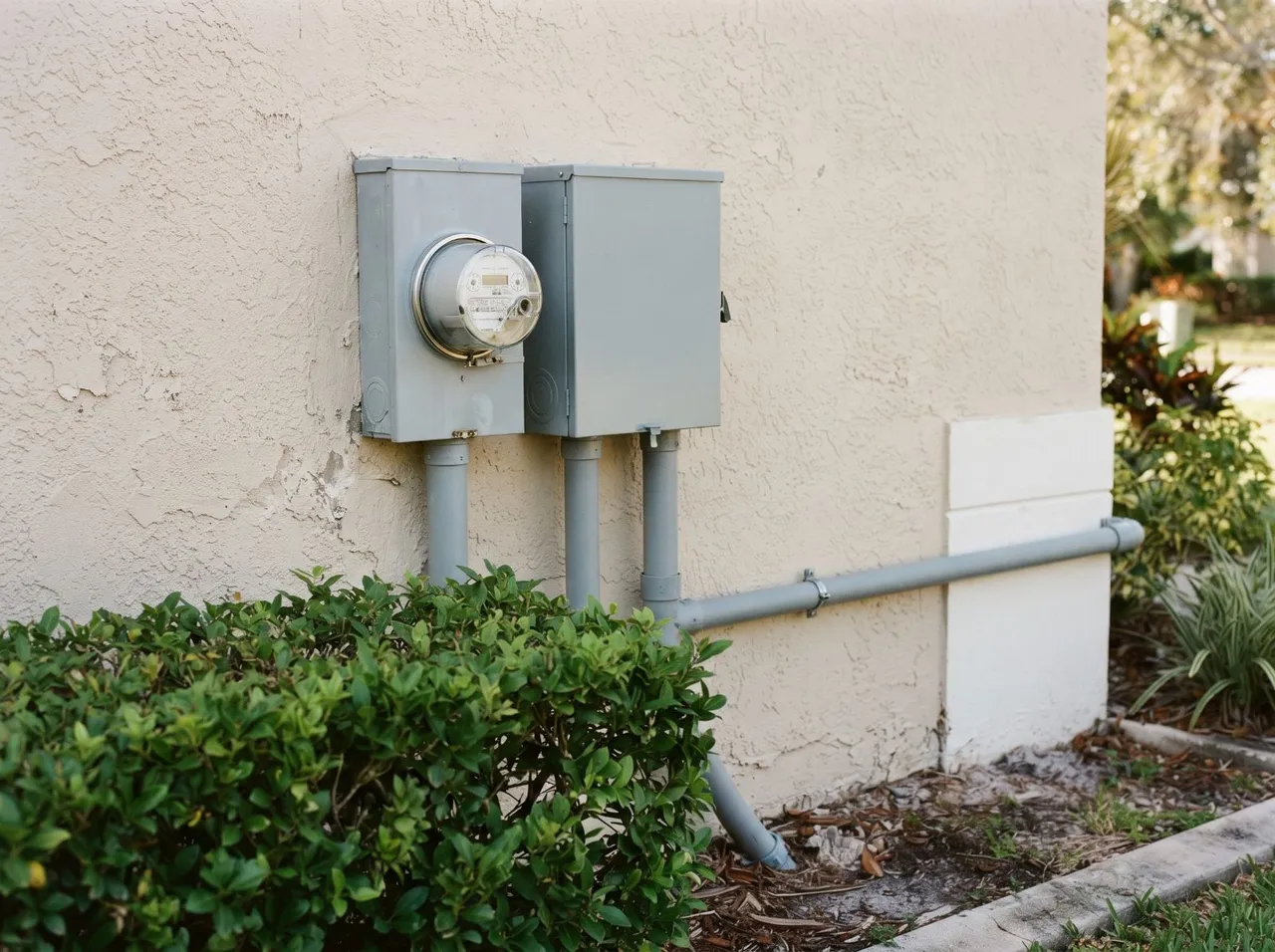
The switch usually mounts on an outside wall next to the electric meter and main panel, or inside beside the panel, depending on how the house is wired. The generator can sit some distance away on its pad, with wire run between them; the farther apart, the more wire and labor. In some homes the switch is installed between the meter and the main panel and also serves as the main disconnect. Whether yours calls for that depends on the panel and local code, and the quote should spell out the plan.
PowerOutage.us puts transfer equipment at roughly $500 to $2,500 within a typical $7,000 to $15,000 Florida install. The spread reflects amperage, whole-house versus 16-circuit, and how much load management is included. The cost guide breaks down the rest.
Questions for the estimate visit:
- What amperage is my service, and what size switch are you quoting?
- Whole-house or 16-circuit? If 16-circuit, which circuits are on it?
- How many large loads does load management control, and which ones?
- Is the switch the same brand as the generator, and how does that affect the warranty?
- Where will it mount, and how long is the wire run to the generator?
The switch and its wiring are inspected by your county or city building department as part of the permitted electrical work. One request gets you a licensed installer who serves your area and handles that, usually with a call back within one business day. The how it works page covers the full timeline.
Straight answers
Free in-home estimate, written price, no obligation.
Get my estimateWhy can't I just plug a portable generator into the dryer outlet?
Back-feeding a house through an outlet can push generator power out onto the utility lines, where it can injure a lineworker who expects the wire to be dead. It can also damage the generator and the house wiring when utility power returns. A transfer switch, installed under permit by a licensed electrical contractor, keeps the house and the grid separated.
How do I find out whether I have 100, 150 or 200 amp service?
Open the panel door and look at the main breaker, usually the largest one at the top, where the number is printed on the handle. Some houses have a separate main disconnect outside by the meter, or two panels. A photo of the breaker and labels helps, and the installer confirms the service size at the free estimate.
Will the lights blink when the switch transfers?
Yes, briefly. When utility power fails the house goes dark, then the generator starts and the switch moves the load over within seconds. When utility power returns there is another short interruption as the switch moves back. Appliance clocks without battery backup may need resetting, and a small battery backup keeps a computer from shutting off.
Which costs less, a whole-house switch or an essential-circuits switch?
A 16-circuit essentials switch generally costs less and pairs with a smaller generator, but only the chosen circuits run during an outage. A whole-house switch lets every circuit run and often uses load management so a mid-size generator can carry it. PowerOutage.us puts transfer equipment at roughly $500 to $2,500 overall.
Does the transfer switch need its own permit and inspection?
The switch and its wiring are part of the permitted electrical work, inspected by the building department that covers your address, whether that is Marion County, Sumter County or a city with its own department. Your installer pulls the permit, schedules the rough and final electrical inspections, and fixes anything the inspector flags.