How a home generator gets installed
From the first phone call to the first outage your house rides through: every step, who handles it, what you do, and how to have it running before the peak storm weeks.
Hurricane Milton, Oct 10, 2024
70,394Marion County electric customers out, 31.3% at the Florida PSC 9 AM report
Or call (352) 780-1430. A licensed installer who serves your area calls back, usually within one business day.
Four to eight weeks, start to power
Most of the wait is paperwork and equipment. The work at your house usually takes one to two days.
Day 1
Free estimate
An installer visits, measures and leaves a written price.
Weeks 1 to 6
Permits and equipment
Electrical and gas permits, HOA approval where needed, the unit ordered.
1 to 2 days
Install
Pad, generator, fuel line and transfer switch go in.
Final week
Inspect and power on
Inspection passes, startup, a walkthrough of the controls.
Why the calendar matters more than the catalog
Free in-home estimate, written price, no obligation.
Get my estimateMost people start shopping for a generator the week after a storm. That is the hardest time to get one. Hurricane season runs from June 1 to November 30, and NOAA puts the usual peak around September 10. Most projects take four to eight weeks from signed estimate to power on, with one to two days of actual work at the house. Count backward from September and the useful window is spring and early summer.
Marion County has seen what happens when the window closes. At the state's 9 AM report on October 10, 2024, after Hurricane Milton, 70,394 Marion customers were without power, and the county later reported a peak of about 75,000. Not every outage comes with a name, either. On July 11, 2026, a line of thunderstorms left about 3,000 to 3,500 Marion customers in the dark at the peak, in the middle of summer heat.
So the process below is written with the clock in mind. One request gets you matched with a vetted, licensed installer who already works in your part of Marion or Sumter County, so you are not calling around while the season ticks by. A call back usually comes within one business day.
Step one: a visit, not a sales pitch
It starts with a free visit. You can pick a time on the calendar, call (352) 780-1430, or send the form on this page. The installer walks around the house and opens your electrical panel. Expect questions, not a pressure pitch at the kitchen table.
What they are checking decides both the size and the price:
- Your electrical service. Most homes have 100, 150 or 200 amp service, and that sets the size of the transfer switch.
- The motors. Central air, a well pump, a pool pump. The nameplates on those motors matter more than your square footage.
- Fuel. Where your natural gas meter is, or where a propane tank could legally sit if no gas main reaches your street.
- Placement. Generac's guidance, citing the NFPA 37 fire code, calls for about 5 feet from windows, doors and vents, 5 feet of open space above the unit, and 3 feet at the front and both ends. Local code takes precedence.
- Distance. How far the generator spot sits from the panel and the fuel source. Every extra foot is wire, pipe and labor.
- Your community. Whether an HOA or ARC review applies before any permit.
You can do some of this homework before anyone arrives. The sizing tool asks about your air conditioners, well, appliances and priorities, and its answer travels with your estimate request, so the installer walks in already knowing what you want to run.
It also helps to have a few things on the counter: a recent electric bill, which names your utility (Ocala Electric Utility, Duke Energy Florida, SECO Energy or Clay Electric in Marion; SECO Energy or Withlacoochee River Electric in Sumter), a gas bill if you have one, your HOA's architectural review contact, and a short list of what must run in an outage, such as the fridge, the AC, the well pump, an oxygen concentrator or a home office.
Step two: the written quote, line by line
After the visit you get a written estimate from the licensed installer. A good one is itemized, so you can see what you are paying for:
- The generator brand, model and kW size
- The automatic transfer switch, its amperage, and any load management modules
- The pad
- The natural gas or propane connection, and the tank if you need one
- Electrical work, permits, inspections and startup
- The warranty, in writing, with its length and what it covers
Typical Florida installs run about $7,000 to $15,000. That is a published range, not a quote; your number comes from your house. The cost guide explains why one home lands near the bottom and another near the top.
Take your time with it. If you want a second brand priced, ask for it at the same visit, with the same kW size, the same switch and the same fuel work, so the two numbers mean the same thing.
If something changes after you sign, such as the HOA asking for a different spot, ask for the change to be priced in writing before the work goes ahead.
Hurricane season runs June 1 to November 30 and peaks around September 10, per NOAA. Sign in spring and most projects are running before the peak.
Step three: paperwork that depends on your address
Once you sign, the installer files the paperwork. In Florida the common pattern is an electrical permit for the transfer switch and panel work, a gas permit for the fuel piping, and sometimes a building permit for the pad. Who issues them depends on where you live: Marion County, Sumter County, or your city's building department if your city runs its own. Your installer pulls them through the right office. You should not need to visit a permit counter.
The work itself calls for a Florida licensed electrical contractor, plus a licensed plumbing or gas contractor for the fuel connection. Ask for those license numbers on the quote.
If you live in an HOA community, there is usually a second approval. Florida Statute 720.3035(6) lets the association set specifications for fixed generators and fuel tanks, and it cannot deny an application that meets them.
The Villages is the clearest local example. Its district ARC manuals require approval before any exterior work starts, and the manual for Districts 13 to 15 says permanently fixed generators go at the rear or side of the home site and must not be visible from the street. Owners who skip the step have been ordered to correct the work within 45 days or face fines. In other communities, plan on an architectural review application before the permit; installers who work there regularly prepare it with you.
On propane, the supplier sets the tank, and your installer coordinates the delivery date with the rest of the schedule.
Steps four and five: install day and inspections
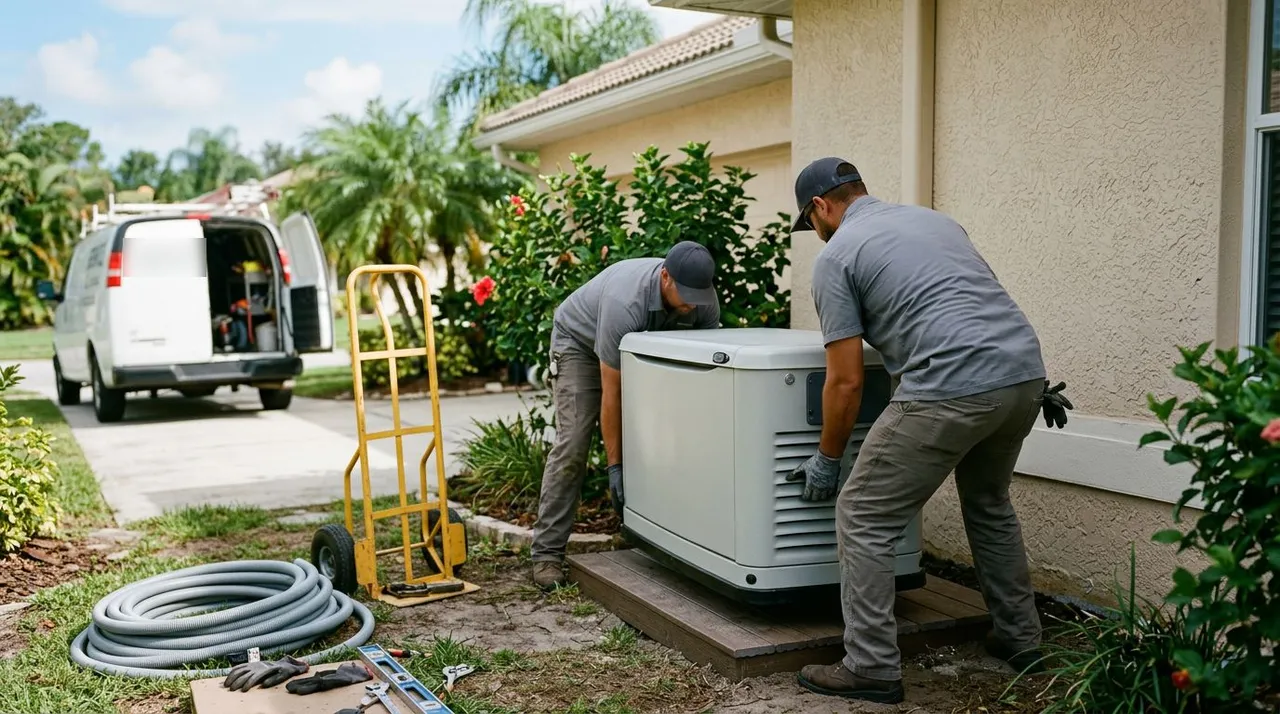
The part everyone pictures is the shortest. One to two days at the house usually covers:
- Setting the pad in the approved spot
- Placing the generator on it
- Mounting the transfer switch beside your meter or main panel and wiring it in
- Running wire between the generator and the switch
- Running and connecting the gas or propane line
Your power is off for part of the day while the switch is tied in. Charge phones, skip the laundry, and tell the crew about pets, gate codes and sprinkler heads near the work area. In a guard-gated community, put the installer's name on the visitor list ahead of time.
Expect a small crew and a few vehicles in the driveway. The pad and the unit usually go in first, then the electrician works at the panel. If the fuel line has to cross the yard, it may need a trench; point out any irrigation lines, buried cables or septic parts you know about so they can be avoided.
Then the building department sends an inspector. In the common Florida pattern that means a rough electrical inspection, a rough gas inspection and a final. Your installer schedules them and fixes anything the inspector flags. The job is not finished until the final passes.
Step six: the first test run and the years after
With the permits closed, the installer starts the generator, runs it under load, and simulates an outage while you watch. When utility power drops, the transfer switch moves your house to the generator within seconds. When power returns, it switches back, and the generator cools down and shuts itself off.
The walkthrough covers the status lights, the weekly exercise run you will hear, and what a warning light means. Generac Guardian units ship with free Mobile Link Wi-Fi monitoring, so ask the installer to set up the app on your phone before they leave. Other brands have their own options, compared on the brands page.
After that, it is an engine that needs care. Generac calls for a yearly check and an oil and filter change every 200 hours or two years, dropping to every 100 hours in heat above 85°F. A long July outage can bring that due date up fast. One survey of the Tampa market put service plans at about $400 to $500 a year. Between visits, keep mulch, plants and stored things out of the clearance zone.
That is the whole path. The first step costs nothing and commits you to nothing.
Straight answers
Free in-home estimate, written price, no obligation.
Get my estimateDoes the estimate visit cost anything?
No. The in-home visit and the written, itemized quote are free, and there is no obligation to buy. A licensed installer who serves your area looks at your panel, your fuel source and where the generator could go. You decide afterward, on your own schedule, whether to go ahead.
Will I have to deal with the county permit office?
Usually not. Your installer pulls the electrical and gas permits through the building department that covers your address, whether that is Marion County, Sumter County or a city that runs its own department, and schedules the inspections. You may be asked to sign a form or two, but the filing and the follow-up are the installer's job.
My community has an ARC. Who handles that?
Plan on submitting an architectural review application before the permit. Installers who work in your community regularly prepare it with you: placement, the unit's specifications and any screening the association asks for. In The Villages, ARC approval must come before any exterior work starts, and Florida Statute 720.3035(6) keeps an association from denying an application that meets its own specifications.
If I start in the spring, will the generator be running by hurricane season?
For most projects, yes. The usual span is four to eight weeks from signed estimate to power on, with one to two days of work at the house. Permits, HOA review and equipment supply set the pace. After a major storm demand jumps and schedules stretch, which is why spring and early summer are the easiest months to start.
What do I need to do after the installer leaves?
Very little. Listen for the short weekly self-test, glance at the status light or the monitoring app now and then, and keep the area around the unit clear. Book yearly maintenance; Generac calls for an oil and filter change every 200 hours or two years, or every 100 hours in heat above 85 degrees, which a long summer outage can reach quickly.