Natural gas or propane
Whether a gas main runs past your house decides most of this. Here is how to check, what each fuel burns, and how long a propane tank carries you through a long outage.
Hurricane Milton, Oct 10, 2024
70,394Marion County electric customers out, 31.3% at the Florida PSC 9 AM report
Or call (352) 780-1430. A licensed installer who serves your area calls back, usually within one business day.
What a 22 kW unit burns
Published fuel use for a common 22 kW air-cooled generator. A day at full load is the worst case; real outages swing between the two as the AC cycles.
Propane, half load2.16 gal per hour · about 52 gallons a day
Propane, full load3.67 gal per hour · about 88 gallons a day
Natural gas, half load184 cu ft per hour
Natural gas, full load281 cu ft per hour
Gas mains, propane tanks and where you live
Free in-home estimate, written price, no obligation.
Get my estimateIn much of Marion and Sumter County, your address makes this choice before you do. Peoples Gas took over Ocala-area gas service in 1997 and serves more than 500,000 customers across Florida, but its mains do not reach every road. Here is how that plays out locally:
- On Top of the World: natural gas shows up in many listings for furnaces, water heaters and ranges, and one listing calls it a community perk. It is not universal; some homes only have a hookup available.
- The Villages: Peoples Gas served about 19,387 customers in Sumter County in 2018. The Villages and the City of Leesburg, through South Sumter Gas Co., have said they want Leesburg to serve future sections, so the provider can differ by section. Check your own address.
- Rural acreage and horse country: expect propane unless you know a main runs along your road. On a farm the generator may also carry barn fans and well pumps, which raises the burn rate and the tank size; the horse farm page covers that case.
- Ocala neighborhoods: some streets have gas, some do not. The address decides.
The quick check is a gas meter on the outside of your house or a gas bill. If you have neither, the installer can look into it at the free estimate. One request gets you a licensed installer who already works in your area, usually with a call back within one business day, so the fuel question is answered by someone who knows the streets.
What a 22 kW generator burns in an hour
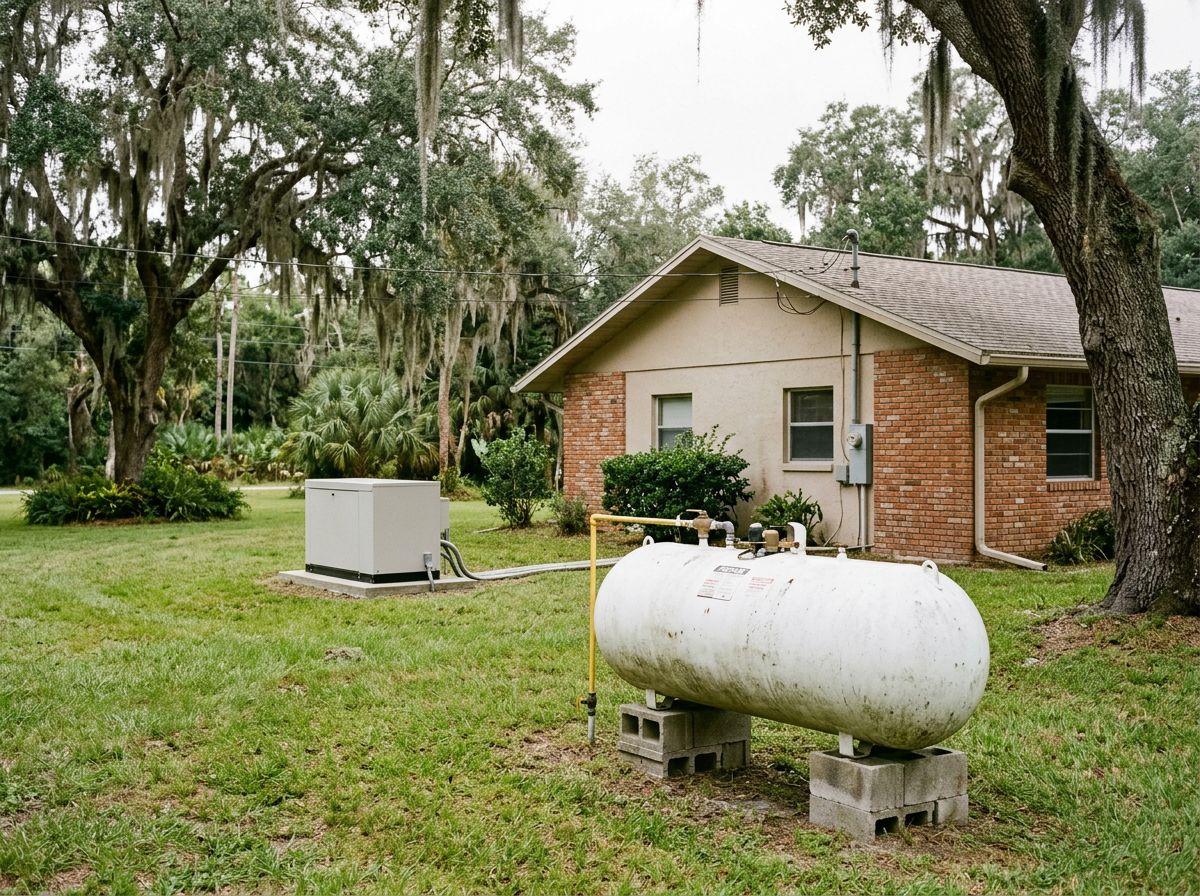
Both fuels run the same generators, but they are measured differently. Natural gas is counted in cubic feet per hour; propane in gallons per hour. Using Generac's 22 kW air-cooled unit as a reference, one published table shows:
- Natural gas: about 184 cubic feet per hour at half load, 281 at full load
- Propane: about 2.16 gallons per hour at half load, 3.67 at full load
Another published spec for a 22 kW unit puts the figures a little higher: 221 and 311 cubic feet of natural gas, 2.45 and 3.71 gallons of propane. Treat both as ballpark. The installer gives you the figures for the exact model on your quote, and bigger generators burn more.
The load figure is the one to watch. A generator rarely runs at full load for long; air conditioners and refrigerators cycle on and off, and nights are lighter than afternoons. A July afternoon with two ACs running sits closer to the top of that range than a mild November night.
One day at half load, on each fuel
Run the 22 kW reference unit at half load for 24 hours and it burns about 4,400 cubic feet of natural gas, or about 52 gallons of propane. The gas simply flows from the main. The propane comes out of a tank that someone has to refill.
Doing the tank math before the storm
Here is the simple version. At half load, 2.16 gallons an hour is about 52 gallons a day. At full load, 3.67 gallons an hour is about 88 gallons a day. Real outages land somewhere in between, but planning on the conservative side is wise.
Then ask how long an outage you are planning for. After Milton, Marion County reported a peak of about 75,000 customers without power, and big storms can leave some streets dark for days. Size the tank for the outage you are worried about, not the average one.
Questions for your propane supplier:
- How many usable gallons does each tank size hold? Tanks are not filled to the very top, so ask about usable gallons rather than the label size.
- How many days of generator run time does that give at half load?
- What are your delivery terms after a hurricane, when every customer calls at once?
- Can the tank also serve a water heater or range, and how does that change run time?
Suppliers are busiest right after a storm, which is exactly when a small tank runs low. A tank sized for several days buys you time until the trucks catch up.
If you already have propane for a water heater or range, the same tank may be able to serve the generator, but check the size first. A tank sized for a range can be far too small for several days of generator run time.
On the morning of Oct. 10, 2024, after Hurricane Milton, 70,394 Marion County customers were without power at the Florida PSC's 9 AM report. Your fuel supply decides how long you ride that out.
Natural gas: enough flow at the meter
With natural gas there is no tank to run dry and no truck to wait for. The question is different: can your meter and piping deliver enough gas at once for the generator plus your other gas appliances, such as a furnace, water heater, range or dryer?
At the estimate, the installer checks the meter size and measures the run from the meter to the generator spot. The pipe is sized to that distance and that load; a long run may need a larger pipe to deliver enough gas. If the meter itself is too small for the added load, the installer coordinates with the gas utility.
That is why the installer adds up every gas appliance, not just the generator. On a cool night during a winter outage, a gas furnace and the generator could both be drawing from the same meter at the same time.
The appeal is easy to see for someone who does not want to watch a gauge during a week-long outage, or who is away for part of the year. As long as the gas utility keeps supplying, the generator keeps running.
What each fuel adds to the bill
PowerOutage.us puts the fuel connection at roughly $500 to $2,000 within a typical $7,000 to $15,000 Florida install. What moves the number:
- Run length. The farther the generator sits from the meter or tank, the more pipe and labor.
- Pipe size. Long runs may need larger pipe.
- Buy or lease the tank. Buying costs more up front and lets you buy propane from any supplier. Leasing costs less up front but usually ties your refills to the company that owns the tank. Ask about both.
- Above ground or buried. A buried tank looks cleaner and may sit better with an HOA, and it adds excavation cost.
- Permits. Fuel piping usually needs its own gas permit and a rough gas inspection.
The generator size is the same whichever fuel you choose, so run the sizing tool first, then let the installer price the fuel side. The cost guide walks through every other line of a typical quote.
Clearances, tanks and HOA review
Both setups have placement rules. Generac's guidance, citing the NFPA 37 fire code, calls for about 5 feet between the generator and windows, doors and vents. Propane tanks have their own placement rules, set by code and by the supplier. Local code takes precedence, and the installer plans the layout to meet it.
In an HOA community, a propane tank is part of the architectural review. Florida Statute 720.3035(6) lists fuel storage tanks alongside fixed generators: the association can set specifications but cannot deny an application that meets them. In The Villages, ARC approval comes before any exterior work, and the Districts 13 to 15 manual keeps fixed generators at the rear or side of the home site, out of view from the street. Elsewhere, installers who work in your community prepare the application with you.
Side by side, the tradeoffs are short:
- Natural gas: no tank, no deliveries, usually a lower connection cost when the meter is close; not available on every street.
- Propane: works anywhere and keeps fuel on your property; run time is capped by tank size, and the tank needs its own spot and approval.
Compare brands while you are deciding on the brands page; every brand there runs on either fuel.
Not sure which way to go? Ask the installer to price both at the estimate. Where gas reaches your street, a side-by-side quote usually settles it quickly, and where it does not, the conversation moves straight to tank size and placement.
Straight answers
Free in-home estimate, written price, no obligation.
Get my estimateWill natural gas keep flowing during a hurricane?
Natural gas depends on the gas utility's supply rather than on truck deliveries, so a gas-fed generator keeps running as long as the utility keeps supplying. No fuel is guaranteed in every disaster, but many owners choose gas so they are not watching a tank gauge or waiting on a delivery during a long outage.
How many days will a propane tank run my generator?
Divide the tank's usable gallons by the generator's burn rate. A 22 kW air-cooled unit burns about 2.16 gallons an hour at half load in one published table, roughly 52 gallons a day. Usable gallons are less than the label size, so ask your supplier for that figure and plan conservatively.
Who supplies natural gas in The Villages?
It depends on the section. Peoples Gas served about 19,387 Sumter County customers in 2018, and The Villages and the City of Leesburg, through South Sumter Gas Co., have stated they want Leesburg to serve future sections. Check your own gas bill or meter, or ask the installer to confirm the provider at your address.
Does a buried propane tank cost more?
Yes. A buried tank adds excavation and setting costs on top of the tank itself. Some homeowners choose one because it looks cleaner and may suit HOA rules better. Ask your propane supplier to price both, and ask the installer how each option changes placement and the length of the fuel line.
Is the fuel line part of the installer's job?
Yes. The gas or propane connection is part of a complete installation, done by a licensed plumbing or gas contractor under a gas permit and inspected by your building department. If you need a tank, the propane supplier sets it, and the installer coordinates the delivery so the tank is ready before startup.