Where a generator goes, and how loud it is
The distances in the manufacturer manuals, who has to approve the spot, and what the published sound ratings mean for you and the folks next door, so you know what to expect before anyone pours a pad.
Hurricane Milton, Oct 10, 2024
70,394Marion County electric customers out, 31.3% at the Florida PSC 9 AM report
Or call (352) 780-1430. A licensed installer who serves your area calls back, usually within one business day.
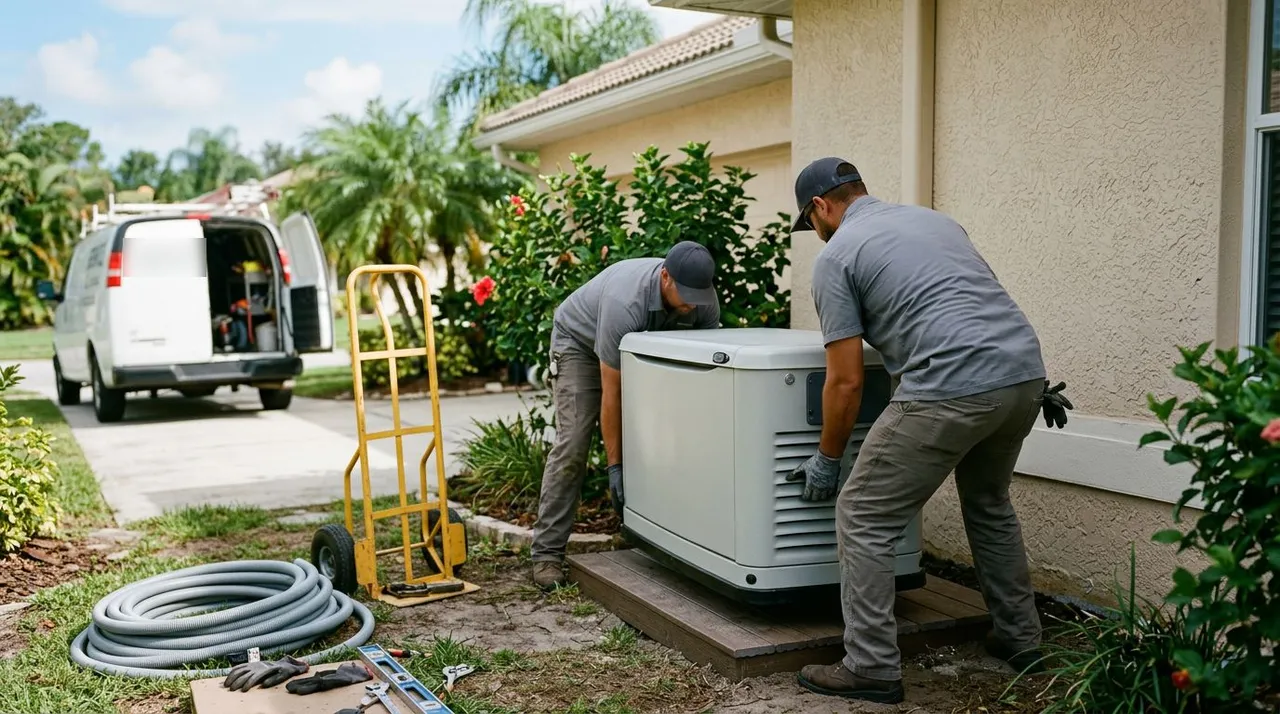
How far a generator has to be from the house
Free in-home estimate, written price, no obligation.
Get my estimateThe short answer most people hear is five feet. That number is real, but it applies to specific things, and it is not the only distance that matters. Generac's current site selection instruction sheet for its home standby units, which cites the NFPA 37 fire standard, lays out the clearances this way:
- Openings: 5 feet from windows, doors, vents, window wells and other openings in the wall. The sheet notes that locally adopted codes decide the final distance.
- Behind the unit: at least 18 inches from the back of the generator to a wall, but only for models marked with the Southwest Research Institute (SwRI) logo, which were fire tested for that closer spacing. Units without the mark follow the standard clearances in their manual.
- Front and both ends: at least 3 feet, and that includes shrubs, bushes and trees.
- Overhead: roof overhangs, soffits and other projections must be at least 5 feet above the top of the generator.
- Combustibles: for units without the SwRI listing, Generac's support article gives 5 feet from combustible materials and 3 feet from non-combustible ones.
Generac also says not to install a home standby generator under a wooden deck or platform.
One more point from the same sheet is worth reading twice. A unit placed to the letter of the fire code can still let exhaust into a home through gaps around doors, windows, soffits and vents, so it may need to sit farther away. That is why the sheet also recommends carbon monoxide detectors on each level of the home next to the generator.
These figures vary by brand and model. The installation manual for the exact unit you buy governs, and local code takes precedence over the manual.
What the Kohler manual says, and why the manual wins
Kohler words its rules a little differently, which is a good reminder that you should not borrow one brand's numbers for another. The installation manual for Kohler's 14RESA, 14RESAL, 20RESC and 20RESCL home generators (TP-6803) says the distance from a structure depends on state and local codes, and its dimension drawing adds:
- Combustible walls: NFPA 37 states the generator should be at least 5 feet from combustible material.
- Non-combustible walls: a minimum of 18 inches is required for proper cooling.
- Exhaust end: the nearest window, vent, door or similar opening should be at least 5 feet from the exhaust end, and furnace and similar air intakes at least 10 feet.
- Plants and clutter: no plants, shrubs or other combustibles within 4 feet of the exhaust end, or within 18 inches of the air intake.
- People spaces: do not locate the generator near patios, decks, play areas or animal shelters.
The Kohler manual also asks for the generator to sit outdoors near the incoming gas service, with the exhaust aimed away from or parallel to the house.
Notice the pattern. Both brands cite NFPA 37, both want room for air and service, and both say local code has the final word. The details differ by model, and manuals are revised over time; the Generac sheet in our sources is dated June 2026, for example. So the right question at your estimate is not "how far is the rule" but "what does the manual for this exact model say, and what does our building department enforce." A good installer will answer both, and will show you on the ground.
Comparing brands? The Generac and Kohler pages cover the lineups.
Who approves the spot: building official, zoning and your HOA
Three different groups can have a say in where the generator sits, and they look at different things.
The building department reviews the permit and inspects the finished job, including the clearances. Which office that is depends on your address. In unincorporated Marion County it is Marion County Building Safety, (352) 438-2400. In unincorporated Sumter County it is Sumter County Building Services, (352) 689-4400 for plan review. Cities that run their own departments handle their own permits. The generator permits page covers the process.
Zoning sets setbacks, the strips along the property lines where structures may not go. Setback distances depend on the zoning district and the lot, and they are written in the county or city land development code. In Marion County, the Planning Division answers how the code applies to a specific property at (352) 438-2600. On narrow villa lots, the side yard is often where a setback and the manual's clearances squeeze together.
Your HOA or ARC can add its own placement rules. The Villages is the clearest local example. The Districts 13 to 15 ARC manual says permanently fixed generators go at the rear or side of the home site, must not be visible from the street, may not sit in any setback or easement, must have the exhaust directed away from neighboring properties, and must be sized to fit the lot. The District Government FAQ says the application must be approved before any work, and the Community Standards team answers questions at (352) 751-3912. Other communities, such as On Top of the World, have their own review rules, so ask the association office for its current guidelines.
Florida Statute 720.3035(6) lists exterior fixed generators and fuel tanks among hurricane protection. An association must adopt specifications for them and cannot deny an application that meets those specifications.
70,394 Marion County electric customers were without power during Hurricane Milton at the Florida PSC 9 AM report on October 10, 2024, two weeks after Helene left 45,704 in the dark.
How loud is a whole-home generator?
Manufacturers publish sound ratings in dB(A), a measure weighted toward how people hear, taken at a set distance. Here is what two spec sheets say:
- Generac Guardian 20, 22 and 24 kW: 67 dB(A) at 23 feet with the generator running at normal load, and 55 to 57 dB(A) at 23 feet during the Quiet-Test low-speed weekly exercise, depending on model. Generac notes these readings are taken from the front, and other sides may be louder depending on the installation.
- Kohler 20RCA: an average of 66 dB(A) during the weekly exercise and 70 dB(A) during full-speed diagnostics and normal operation, measured at 23 feet. Kohler notes this is the lowest of eight points measured around the unit.
Those two notes matter. A rating is one reading at one distance. Your neighbor's bedroom window might be closer than 23 feet, and a wall or fence behind the unit can bounce sound around.
For everyday comparison, the American Academy of Audiology's noise chart places normal conversation and dishwashers at 60 dB, and traffic and vacuums at 70 dB. So a generator under load, heard from across a typical side yard, sits in the same band as a vacuum or road noise, and the weekly low-speed test is closer to conversation. The same chart says hearing protection is recommended above 85 dB, well above these ratings.
The generator runs under load only when the power is out, and on a storm night most of the neighborhood is listening to its own generators, fans and wind. What neighbors notice in ordinary weeks is the exercise run, which is why the next section matters.
Choosing a spot the neighbors will not mind
Most placement friction comes from small things that are easy to plan for at the estimate:
- Point the exhaust away. Kohler's drawing calls for the exhaust aimed away from or parallel to the house and not at patios or places people gather. The Villages Districts 13 to 15 manual requires the exhaust to point away from neighboring properties. It is a good courtesy anywhere.
- Mind the bedroom side. Within the rules, a spot along a garage wall or a blank side of the house usually bothers fewer people than one under a bedroom window, yours or theirs.
- Set the exercise for a friendly hour. Generac says the exercise date and time can be set on the control panel or in its Mobile Link app. Kohler's 20RCA spec sheet lists weekly, every-other-week or monthly exercise intervals. A weekday late-morning test is easier on everyone than an early Saturday one.
- Screen it the approved way. Generac allows a removable fence as a visual surround, but no panel may sit within 3 feet of the generator, and it warns against hiding the unit in shrubs. The Villages Districts 13 to 15 manual allows fences to screen a generator if they are no higher than the generator. Keep plantings outside the clearance zones; Kohler keeps them 4 feet from the exhaust end.
- Talk to the neighbor first. A two-minute heads-up about where it will go and when the weekly test runs heads off most complaints.
If your lot is tight, ask the installer to sketch two or three candidate spots with the clearances drawn in. Seeing the options side by side makes the trade-offs between noise, looks and the length of the fuel and wire runs much easier to judge.
Water, the pad and the fuel connection
Central Florida rain decides a lot about placement. Generac's site selection sheet asks for high ground where water will not rise into the unit, and for a spot where gutter downspouts, roof runoff, sprinklers and sump pump discharge will not flood or spray the enclosure. Moisture shortens a generator's life. On a lot that holds water after a summer storm, that may mean a raised base or a different side of the house.
The base matters too:
- Generac: typically approved for pea gravel, crushed stone or a concrete pad, level within half an inch, with any pad meeting local codes for wind ratings. A gravel base is prepared about 5 inches thick and about 3 inches larger than the unit on all sides.
- Kohler: a flat, level area with a weed barrier and gravel or a concrete pad, never directly on grass or wood.
Then there is fuel. Kohler's manual places the generator near the incoming gas service, and Generac recommends a spot as close as possible to the transfer switch and the fuel supply while still meeting the other rules. Generac says the required distance from the gas meter is in each model's installation manual, and that laws and codes may regulate distance to specific utilities, so installers check with the local utility before installing. If you are on natural gas from TECO Peoples Gas, the meter location shapes the plan. On propane, the tank has its own placement rules set by code and handled by your supplier. The natural gas vs propane guide covers both.
Every foot between the generator, the panel and the fuel source adds wire, pipe and labor, so placement is also a price decision. The cost page shows how that adds up.
At a free estimate, a licensed local installer measures the clearances, checks the meter or tank location, and marks the spot on your lot. Call (352) 780-1430 or pick a time.
Straight answers
Free in-home estimate, written price, no obligation.
Get my estimateHow far does a generator need to be from the house?
It depends on the model and your local code. Generac's site selection sheet, citing NFPA 37, calls for 5 feet from windows, doors and vents, 5 feet clear overhead, 3 feet at the front and ends, and 18 inches behind SwRI-listed units. Kohler's manual for its 14 and 20 kW models gives 18 inches from non-combustible walls and 5 feet from combustible material. The manual for your unit and your building department have the final word.
Can a generator go right up against my house?
Not right against it. Even the closest spacing in the manuals we reviewed leaves 18 inches behind the unit, and Generac allows that only for models listed by the Southwest Research Institute. Openings such as windows, doors and vents still need more room, 5 feet in both the Generac and Kohler documents. The installer measures your wall and openings at the estimate.
How loud is a Generac generator?
Generac's spec sheet for its 20, 22 and 24 kW Guardian units lists 67 dB(A) at 23 feet under normal load and 55 to 57 dB(A) during the low-speed Quiet-Test weekly exercise. Those readings are taken at the front, and Generac notes other sides may be louder depending on the installation. For comparison, a noise chart from the American Academy of Audiology puts normal conversation at 60 dB.
Will my neighbors in The Villages hear it?
They may hear the weekly exercise and any outage run. You can help by aiming the exhaust away from their home, which the Districts 13 to 15 ARC manual requires, keeping the unit at the rear or side and out of view from the street, and setting the exercise for a weekday daytime slot. The ARC application must be approved before work starts.
Who decides where the generator can go?
Several parties. The manufacturer's manual sets clearances. Your building department, such as Marion County Building Safety or Sumter County Building Services, reviews the permit and inspects the job. Zoning sets property-line setbacks. Your HOA or ARC can add placement and screening rules, and under Florida Statute 720.3035(6) it cannot deny an application that meets its adopted specifications.
Can I hide the generator with shrubs or a fence?
Partly. Generac warns against concealing the unit with shrubs and keeps plants out of the 3-foot front and end clearance. It allows a removable fence as a visual surround if no panel is within 3 feet. Kohler keeps plants 4 feet from the exhaust end. In The Villages, the Districts 13 to 15 manual allows a screening fence no higher than the generator.
Does the generator need to be raised for flooding?
It needs to sit where water will not rise into it. Generac's site selection sheet asks for high ground, away from downspouts, roof runoff, sprinklers and sump discharge, on a level base of gravel or concrete that meets local codes. On a low or soggy lot, the installer may suggest a raised base or another side of the house.